The steady expansion of countertop cooking appliances reflects a deeper shift in how domestic kitchens are organized and used. Rising urban density, smaller household sizes, and increased attention to time management have all contributed to a preference for appliances that compress multiple cooking functions into a single footprint. Within this environment, dual-zone air fryer ovens have emerged as a response to a specific limitation of earlier air fryers: the inability to prepare different foods at the same time without compromise.
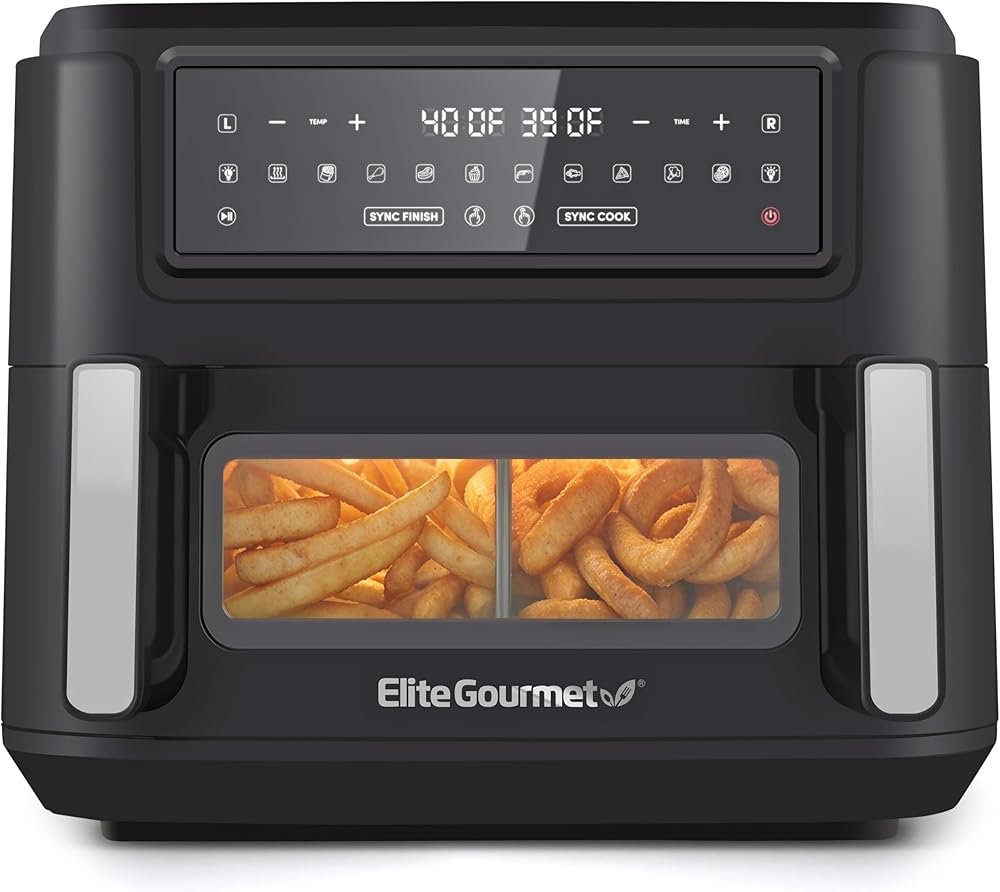
The Elite Gourmet Dual Zone Air Fryer Oven, 11-Qt with Divider exemplifies this design philosophy. Its defining feature is not raw capacity alone, but the ability to divide that capacity into two independently managed cooking spaces. This article examines the technical logic behind that approach, situates the appliance within broader trends in infrared and convection cooking, and evaluates its relevance against compact infrared air fryer designs and single-zone systems that still dominate much of the market.
From Single Chamber to Dual Zone: Why Division Matters
Early consumer air fryers were structurally simple: one basket, one fan, one heating element. That configuration worked well for single dishes but created friction when meals involved items with different timing or temperature requirements. Research into household cooking behavior published by the U.S. Department of Agriculture shows that dinners prepared at home frequently involve “two or more distinct components requiring different preparation times,” particularly when protein and vegetables are cooked together. This pattern is documented in consumer food behavior analysis from the U.S. Department of Agriculture.
Dual-zone appliances attempt to address that mismatch. By introducing a physical divider and independent airflow management, they allow simultaneous cooking without forcing compromise. In practical terms, this design reduces sequencing delays and reheating cycles, both of which contribute to uneven textures and increased energy use.
The Elite Gourmet 11-Qt model adopts this architecture by splitting its interior into two chambers when the divider is installed, while still permitting full-cavity use when it is removed.
Capacity and Household Scale
At eleven quarts, the Elite Gourmet unit occupies a space typically associated with family-oriented appliances. Consumer data from Statista indicates that air fryers above ten quarts are most often purchased by households with three or more occupants, while smaller models trend toward single-person or couple households. This ownership pattern appears in Statista’s U.S. air fryer usage data.
This distinction is relevant when comparing the Elite Gourmet design with smaller platforms such as a compact infrared air fryer or the t-fal 6 qt air fryer. Those appliances prioritize speed and storage efficiency over parallel throughput. The Elite Gourmet model instead assumes a cooking pattern where multiple dishes reach completion within the same service window.
Divider Systems and Airflow Engineering
A divider alone does not create true dual-zone functionality. Airflow behavior determines whether zones remain independent or bleed into one another. Engineering studies on convection ovens show that airflow uniformity is sensitive to internal geometry, fan placement, and exhaust pathways. These principles are outlined in thermal engineering references available through ScienceDirect.
Elite Gourmet’s divider design relies on physical separation rather than software coordination. Each zone receives circulated air from a shared fan system, with the divider acting as a baffle. This differs from synchronized finish air fryer designs that use sensors and timing algorithms to align completion times across zones.
The advantage of the mechanical divider approach lies in predictability. Fewer sensors reduce calibration complexity, though they also limit precision when foods require sharply different temperature curves.
Dual Zone Versus Infrared Approaches
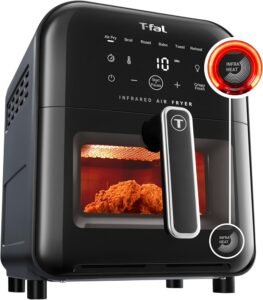
Many recent appliances emphasize infrared heating as a way to accelerate surface browning. Models discussed in a typical t-fal infrared air fryer review often highlight radiant heat transfer as a path to shorter cook times. According to the U.S. Department of Energy, infrared heating “transfers energy directly to the food surface, reducing warm-up losses.” This mechanism is described in efficiency guidance published by the U.S. Department of Energy.
The Elite Gourmet Dual Zone Air Fryer Oven does not rely on infrared elements. Instead, it uses high-velocity convection to achieve even heat distribution. This difference becomes significant when comparing infrared heating air fryer benefits with dual-zone flexibility. Infrared excels in speed for single dishes; dual-zone convection excels in coordination across multiple dishes.
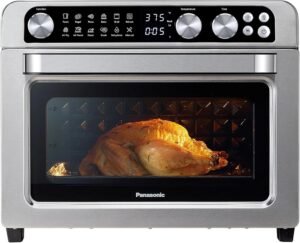
Households that prioritize batch cooking and simultaneous preparation may value zoning over raw speed, while those focused on single-item efficiency may prefer infrared air fryer toaster oven designs.
Cooking Modes and Functional Scope
The Elite Gourmet unit is marketed as a multifunction oven, supporting air frying, baking, roasting, broiling, reheating, and dehydration. As with most modern appliances, these modes are not separate systems but programmed variations in temperature, airflow rate, and time.
Academic analysis of household convection appliances shows that such mode differentiation is primarily algorithmic rather than mechanical, with microcontrollers adjusting fan cycles and heater output. This principle is discussed in engineering literature indexed through IEEE Xplore.
In practical use, the dual-zone configuration allows different modes to run simultaneously on each side. This is the feature that differentiates the Elite Gourmet design from a 7 in 1 air fryer toaster combo that operates within a single cavity.
No-Shake Technology and User Labor
Traditional basket air fryers often require manual agitation to expose food surfaces evenly. The concept marketed as no shake air fryer technology aims to reduce that requirement through airflow optimization. Studies on forced convection cooking indicate that higher air velocity and turbulent flow reduce the need for manual repositioning. These findings are detailed in technical publications from the American Society of Agricultural and Biological Engineers.
The Elite Gourmet oven-style form factor supports this principle more effectively than deep baskets. Food rests on trays rather than stacked layers, allowing air to circulate freely. While this does not eliminate all variability, it reduces the need for user intervention, particularly for items such as vegetables or frozen foods.
Health and Nutritional Context
Air frying continues to be associated with reduced oil use compared to deep frying. Harvard Health Publishing notes that air fryers can “cut calories by 70% to 80%” in certain fried foods by minimizing added fat. This assessment appears in public health guidance from Harvard Health Publishing.
Dual-zone functionality does not alter nutritional outcomes directly, yet it affects preparation patterns. Cooking multiple components at once reduces reliance on reheating, which can degrade texture and moisture. From a food safety perspective, shorter holding times align with guidance from the World Health Organization regarding safe temperature maintenance.
Energy Use and Efficiency
Countertop air fryer ovens typically draw between 1500 and 1800 watts. The U.S. Energy Information Administration reports that such appliances consume between 1.2 and 1.8 kilowatt-hours per hour of operation, depending on duty cycle. This data appears in residential energy use summaries from the U.S. Energy Information Administration.
Dual-zone cooking can improve overall efficiency by consolidating tasks that would otherwise run sequentially. Running two zones within a single appliance often consumes less energy than operating separate devices or extending cooking time in a single-zone unit.
This efficiency gain contrasts with fast cooking air fryer oven designs that prioritize shorter cycles but still require multiple runs for full meals.
Maintenance, Coatings, and Durability
Interior coatings affect long-term usability. Nonstick surfaces simplify cleaning but require temperature discipline. The U.S. Food and Drug Administration states that PTFE-based coatings are safe when used within recommended limits. This guidance is published in consumer materials from the Food and Drug Administration.
Dual-zone ovens introduce additional surfaces, including the divider itself. This increases cleaning time but also distributes residue more evenly, reducing localized buildup. Reviews of large dual-zone appliances frequently note that maintenance effort scales with cooking frequency rather than capacity.
Market Position Against Infrared Models
The rise of infrared-focused products, including the t-fal digital air fryer oven line, reflects demand for speed and compactness. Those appliances align well with smaller kitchens and single-dish preparation.
The Elite Gourmet Dual Zone Air Fryer Oven instead addresses coordination. Its design philosophy assumes that meals consist of multiple components prepared concurrently. This places it in a different segment from compact infrared air fryer systems, even though both occupy the same countertop category.
Neither approach replaces the other. They represent parallel responses to different cooking habits.
Consumer Behavior and Expectation Alignment
Appliance satisfaction research consistently shows that dissatisfaction often results from expectation mismatch rather than mechanical failure. Studies published in the Journal of Consumer Research identify alignment between household routines and appliance capabilities as the strongest predictor of long-term satisfaction. These findings are discussed in behavioral research available through The University of Chicago Press Journals.
Dual-zone appliances reward users who plan meals with parallel cooking in mind. Users expecting infrared-level speed for single dishes may find the benefits less apparent. Understanding this distinction clarifies why reviews of the same appliance can diverge sharply.
Final Considerations
The Elite Gourmet Dual Zone Air Fryer Oven, 11-Qt with Divider represents a structural response to the complexity of modern home meals. Rather than pursuing maximum speed through infrared heating, it prioritizes coordination through physical separation and shared convection.
When compared with infrared air fryer toaster oven designs or compact single-zone systems, its value lies in parallelism rather than acceleration. For households where meals involve multiple components reaching readiness together, that distinction carries practical weight. As countertop cooking continues to diversify, the presence of both dual-zone convection ovens and infrared-driven models suggests a market shaped less by technological hierarchy and more by how kitchens are actually used.