
Countertop cooking appliances have become a quiet but measurable indicator of how domestic routines adapt to constraints of space, time, and energy. Over the past decade, air fryers have shifted from novelty to fixture, propelled by changing household structures and increased scrutiny of cooking methods. Within that crowded field, the COSORI TurboBlaze 9-in-1 Air Fryer, 6-Qt Ceramic Coated positions itself around three central claims: faster airflow, expanded functional range, and alternative surface materials.
This article examines the TurboBlaze model as a technical system rather than a lifestyle object. Its design choices are assessed against peer devices, existing food science research, consumer safety data, and broader trends in home cooking technology. The aim is not to rank or endorse, but to clarify what the appliance represents within a maturing category.
Air Fryers as a Category: Measurable Growth and Shifting Expectations
Air fryer adoption has followed a steep curve. According to ownership data compiled by Statista, air fryer penetration in U.S. households rose from under 10 percent in 2015 to over 35 percent by 2023, placing the category alongside microwaves and slow cookers in everyday relevance. This trend is documented in Statista’s air fryer ownership data.
This growth correlates with two structural changes. First, household size has declined. The U.S. Census Bureau reports that single-person households now account for nearly 29 percent of all U.S. households, a demographic shift outlined in recent Census Bureau reporting. Second, cooking time has become compressed. The U.S. Department of Agriculture notes that average daily food preparation time has fallen steadily since the early 2000s, according to analysis published by the USDA Economic Research Service.
Air fryers address both pressures: compact footprint, rapid heating, and reduced oil handling. The COSORI TurboBlaze enters this context with a design that emphasizes speed without increasing capacity beyond the now-standard six-quart range.
TurboBlaze and High-Velocity Airflow
COSORI describes TurboBlaze as a high-speed airflow system designed to shorten cook times. From an engineering standpoint, this aligns with established principles of forced convection. Heat transfer literature shows that increased air velocity raises convective heat transfer coefficients, accelerating surface dehydration and browning, a mechanism explained in engineering references available via ScienceDirect.
Air fryers rely on this effect. Harvard Health Publishing explains that air fryers cook food by “circulating hot air at high speed,” enabling browning reactions similar to frying while using little or no added oil. This description appears in a public health overview from Harvard Health Publishing.
TurboBlaze does not introduce a new thermal mechanism. Its distinction lies in fan performance and airflow geometry. Higher airflow can shorten cooking cycles for certain foods, particularly frozen items or thin cuts. At the same time, elevated velocity increases moisture loss, which affects texture outcomes for delicate foods.
Capacity and Portion Logic at Six Quarts
The six-quart size has become a midpoint standard across the category. It accommodates meals for two to four people without the counter demands of larger ovens. Consumer research suggests that this size range aligns with the needs of small families and shared households, which represent a growing share of appliance buyers, as reflected in market segmentation data from Statista.
The COSORI TurboBlaze does not attempt to exceed this range. That decision places it alongside compact air fryer designs rather than family-scale ovens. The implication is functional clarity: the appliance targets speed and consistency for moderate portions rather than simultaneous multi-dish preparation.
Nine Functions and the Meaning of Multiplicity
The TurboBlaze is marketed as a 9-in-1 air fryer. Typical modes include air fry, roast, bake, broil, reheat, keep warm, and dehydration variants. From a technical perspective, these are parameter sets rather than separate systems.
Engineering analyses of countertop convection appliances show that such modes adjust temperature ceilings, fan duty cycles, and time limits rather than activating distinct hardware paths. This behavior is examined in control-system research indexed through IEEE Xplore.
This distinction matters. A 9-in-1 label signals flexibility, yet outcomes depend on user understanding of airflow and loading. Dehydration, for instance, requires low temperatures and extended time. In small chambers, airflow uniformity plays a larger role than preset selection.
Ceramic Coating and Material Considerations
One of the TurboBlaze’s defining features is its ceramic-coated basket. This choice reflects ongoing consumer concern around traditional nonstick surfaces. The U.S. Food and Drug Administration states that PTFE-based coatings are safe for household use within recommended temperature limits, while also acknowledging that alternative coatings exist for consumers seeking different material profiles, as outlined by the Food and Drug Administration.
Ceramic coatings are often marketed around ease of cleaning and perceived inertness. Independent materials testing indicates that ceramic coatings offer lower surface friction initially, though durability varies by formulation and usage patterns. These findings are discussed in comparative cookware analysis published by Consumer Reports.
In air fryers, basket coatings endure repeated thermal cycling and abrasion from food contact. Longevity depends less on coating type alone and more on cleaning habits, temperature discipline, and utensil choice.
Health Outcomes and Oil Reduction Claims
Air frying’s association with reduced oil intake is one of its most cited benefits. A study published in the Journal of Food Science found that air-fried potatoes contained “significantly lower fat content than deep-fried samples,” while maintaining comparable sensory acceptability. The study is accessible through the Institute of Food Technologists online library.
That reduction stems from cooking method rather than appliance brand. TurboBlaze’s faster airflow may shorten exposure time, which can affect moisture retention. At the same time, high temperatures raise other considerations. The World Health Organization notes that high-temperature cooking methods can increase acrylamide formation in starchy foods, a factor influenced by both temperature and duration, as outlined in WHO food safety guidance.
Energy Use and Efficiency in Practice
Countertop air fryers typically draw between 1,500 and 1,800 watts during active heating. The U.S. Energy Information Administration reports that small cooking appliances often use less total energy than conventional ovens, especially when preheating is avoided. This comparison appears in residential energy summaries published by the U.S. Energy Information Administration.
TurboBlaze’s emphasis on speed may reduce total runtime for certain foods. From an energy perspective, shorter cycles translate into lower cumulative consumption, though instantaneous load remains similar to other devices in its class.
This efficiency advantage becomes most apparent in reheating and small-batch cooking, where traditional ovens operate far below capacity.
User Interaction and Learning Curves
COSORI equips the TurboBlaze with digital controls and preset programs. Research in human-computer interaction shows that digital interfaces reduce variability in user input while increasing dependence on preset logic. These dynamics are examined in peer-reviewed studies available via Taylor & Francis Online.
For experienced users, presets serve as starting points rather than endpoints. Airflow-heavy systems respond strongly to basket loading density and food geometry. Overcrowding reduces effective convection, while uneven spacing produces variable results.
This behavior is consistent across air fryers and highlights a broader pattern: appliance performance depends as much on user adaptation as on mechanical design.
Maintenance, Cleaning, and Real-World Durability
Ease of cleaning remains a decisive factor in long-term satisfaction. Consumer research consistently ranks cleaning effort alongside noise and capacity as primary determinants of appliance approval.
Ceramic coatings simplify residue removal in early use. Over time, buildup depends on temperature management and cleaning frequency. Dishwasher compatibility varies by component and manufacturer guidance.
Mechanical simplicity aids durability. TurboBlaze follows the standard air fryer architecture: heating element, fan, basket. Fewer moving parts reduce failure points, though fan motors remain the most stressed component under high-velocity operation.
Position Within a Crowded Market
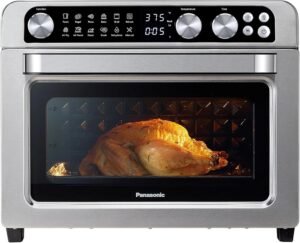
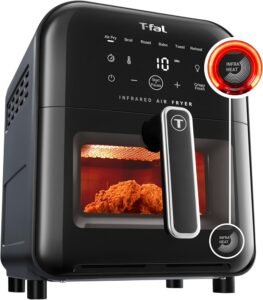
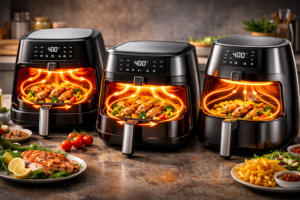
The air fryer market now spans compact infrared models, dual-zone ovens, and hybrid toaster-air fryer combinations. TurboBlaze occupies a middle ground: single-zone, moderate capacity, speed-focused.
It does not attempt the parallel cooking of dual-basket systems, nor the infrared emphasis seen in some toaster-oven hybrids. Instead, it refines conventional convection airflow within a familiar form factor.
This positioning aligns with a segment of users seeking faster everyday cooking without expanding footprint or complexity.
Consumer Expectation and Satisfaction Patterns
Studies in consumer behavior suggest that appliance satisfaction hinges on alignment between expectations and daily routines. Research published in the Journal of Consumer Research identifies expectation fit as a stronger predictor of satisfaction than feature count. This relationship is discussed in behavioral analysis available through The University of Chicago Press Journals.
Users expecting TurboBlaze to replace an oven may encounter limitations. Users treating it as a rapid countertop cooker for small meals tend to report higher satisfaction. This divergence mirrors patterns seen across the category.
Final Considerations
The COSORI TurboBlaze 9-in-1 Air Fryer, 6-Qt Ceramic Coated reflects a mature stage in air fryer evolution. Rather than expanding capacity or introducing new heating physics, it refines airflow speed, interface clarity, and surface materials within established constraints.
Its significance lies less in novelty than in optimization. As domestic cooking continues to fragment across household sizes and schedules, appliances that prioritize speed, manageable scale, and predictable outcomes will remain relevant. TurboBlaze represents one such response, shaped not by spectacle, but by incremental adjustment to how kitchens are actually used.