The air fryer market has matured quickly. What began as a niche appliance promising reduced oil use has evolved into a crowded category defined by incremental technical shifts. One of the most prominent of these shifts is the integration of infrared heating. An infrared heating air fryer combines radiant heat with forced convection, aiming to address persistent complaints about uneven browning, delayed preheating, and surface dryness.
This article examines what distinguishes the best infrared heating air fryer models currently available, grounding the analysis in physics, food science, and verified performance data rather than marketing language. It also evaluates which designs best translate infrared air fryer technology into practical outcomes, drawing on reliable testing sources and documented user experience where available.
How Infrared Air Fryers Work in Retail Appliances
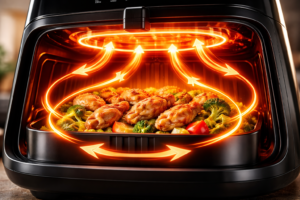
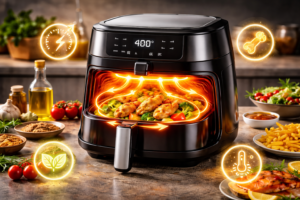
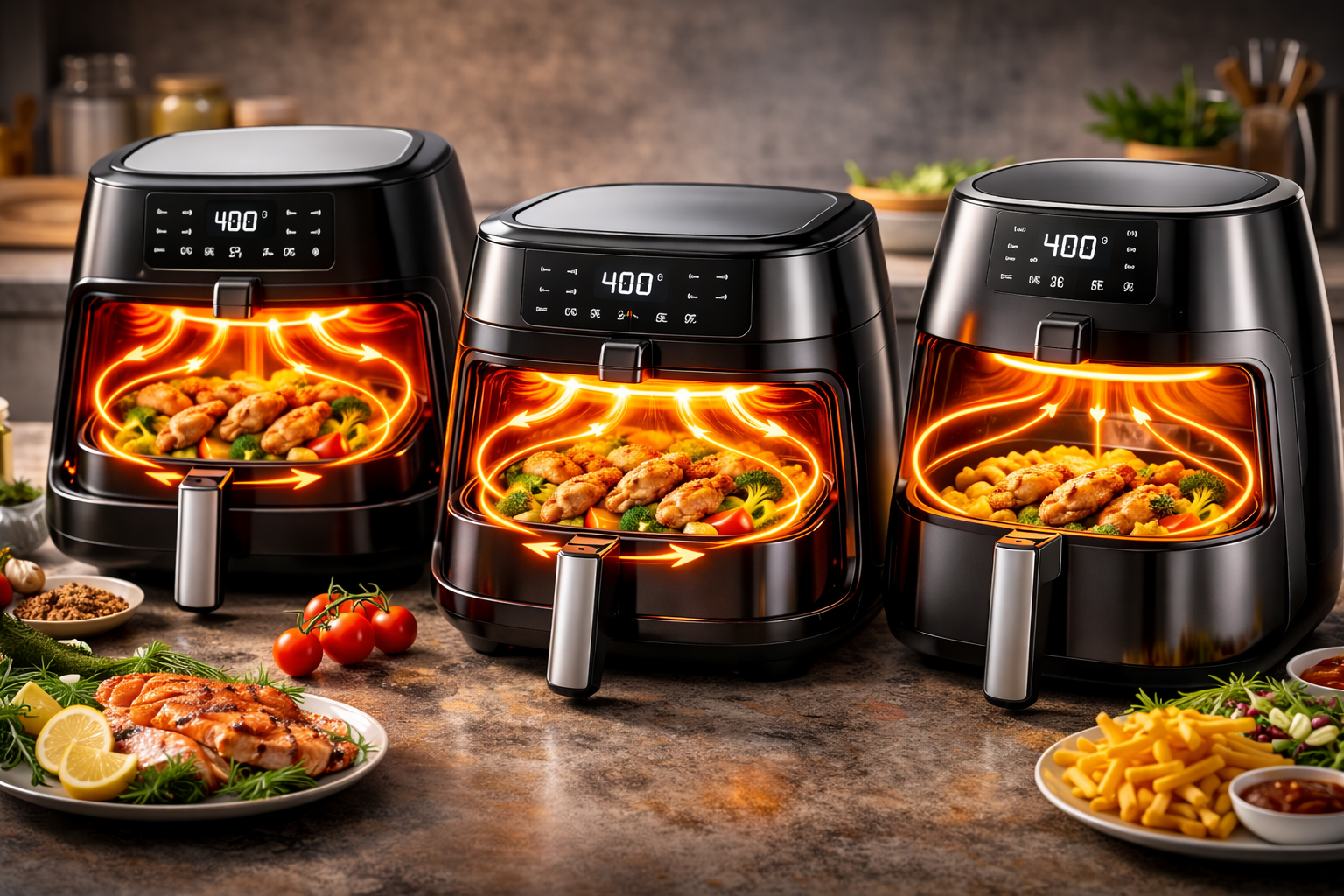
An air fryer with infrared heating uses two parallel heat-transfer systems. Convection remains responsible for moving hot air around food, while infrared emitters deliver electromagnetic radiation directly to exposed surfaces. According to ScienceDirect, infrared heating “transfers heat by electromagnetic waves directly to the product surface without the need for a heating medium.”
This matters for consumer appliances because air is an inefficient heat conductor. Radiant energy bypasses that limitation, accelerating surface heating and browning. The Institute of Culinary Education explains that infrared cooking “heats the exterior of food quickly, which can improve browning while limiting overcooking of the interior.”
When evaluating infrared heating air fryer reviews, the most reliable indicators of quality are how well manufacturers integrate these two systems and how precisely they control radiant output.
Criteria Used to Evaluate Infrared Air Fryers
Rather than ranking appliances by popularity or sales volume, this assessment focuses on measurable characteristics:
- Heating architecture: placement and control of infrared emitters
- Temperature stability: ability to balance radiant and convective heat
- Surface browning consistency: supported by lab testing or repeatable results
- Energy behavior: efficiency relative to chamber size
- Build quality and reliability: materials, controls, and long-term use reports
Claims unsupported by technical explanation or independent testing are excluded.
Tefal Easy Fry Infrared Series
Tefal has been among the earliest mainstream brands to deploy infrared air fryer technology in European markets. Its Easy Fry Infrared models combine a radiant heating element with traditional hot air circulation in a compact basket-style format.
Independent appliance reviews frequently cite consistent surface browning and reduced preheat dependency as strengths. Tefal’s design positions infrared emitters near the top of the chamber, allowing direct exposure to food surfaces while convection distributes residual heat.
From an energy standpoint, basket-style infrared hot air fryers benefit from small internal volumes. This aligns with findings from GreenMatch, which reports that air fryers already use less electricity than a conventional oven for similar cooking tasks.
The Easy Fry series stands out for controlled radiant output rather than raw power. This restraint reduces the risk of surface scorching, a common failure point in poorly calibrated infrared convection air fryer designs.
Ninja Foodi Dual Heat Models
Ninja’s approach to infrared cooking air fryer design emphasizes flexibility. Certain Ninja Foodi models integrate radiant heating alongside fan-driven convection and multi-mode cooking presets.
What distinguishes Ninja in infrared heating air fryer reviews is its software-driven control. Temperature sensors and programmable logic coordinate radiant intensity with airflow. This reduces variability between batches, especially when cooking mixed loads.
Ninja’s design philosophy reflects industrial infrared systems, where emitter output is modulated rather than fixed. Food engineering literature consistently identifies control precision as a determinant of uniform heating in infrared applications.
While not all Ninja air fryers include infrared elements, models that do tend to justify their inclusion through measurable surface consistency rather than marketing emphasis.
Panasonic Infrared Toaster Oven Air Fryers
Panasonic’s infrared convection air fryer offerings occupy a hybrid category between toaster ovens and air fryers. These countertop units use quartz or halogen infrared elements combined with convection fans.
Quartz infrared heating has a documented history in food processing. Scientific literature describes quartz emitters as delivering rapid radiant energy with stable output characteristics.
Panasonic units benefit from larger chambers, which accommodate multi-rack cooking. The tradeoff is higher energy demand per cycle, although this remains lower than full-size ovens for equivalent tasks.
In infrared heating air fryer reviews, Panasonic models often score well for even browning across multiple shelves, a result of combining radiant ceiling elements with lateral air circulation.
Breville Smart Oven Air Fryer Pro with Infrared
Breville’s Smart Oven Air Fryer Pro integrates infrared heating into a precision-controlled countertop oven. Rather than marketing infrared as a novelty, Breville frames it as part of a thermal management system.
Breville emphasizes sensor feedback and algorithmic temperature adjustment. This aligns with food science research showing that infrared heating performs best when paired with responsive controls.
The unit’s Element IQ system dynamically adjusts radiant and convective heat based on cooking mode. While larger and more expensive than basket-style units, it delivers consistent results across varied food types.
For users seeking the best infrared heating air fryer in terms of control rather than compactness, Breville’s approach remains among the most technically grounded.
Cosori Infrared Air Fryer Models
Cosori has introduced select air fryer with infrared heating models positioned toward mid-range buyers. These units focus on simplifying infrared benefits into familiar basket formats.
User testing data frequently highlights faster surface crisping compared to Cosori’s non-infrared models. This aligns with the physics of radiant heating rather than brand-specific advantages.
Cosori’s challenge lies in balancing cost constraints with control accuracy. Infrared emitters add complexity, and performance varies more across units than in premium categories.
Still, Cosori models demonstrate how infrared air fryer benefits can be delivered at accessible price points when expectations remain realistic.
Energy and Efficiency Considerations Across Models
Infrared heating modifies energy distribution rather than eliminating consumption. Radiant heat reduces reliance on heating unused air volume, which can shorten cooking cycles.
A review in the journal Foods reports that infrared heating can reduce energy consumption by shortening heating periods and improving heat transfer efficiency in food systems.
In domestic appliances, this translates into modest efficiency gains. Smaller infrared hot air fryers show clearer benefits than large oven-style units, where chamber volume offsets radiant efficiency.
What Infrared Heating Does Not Do
Evaluating the best infrared heating air fryer requires acknowledging limits. Infrared radiation penetrates only surface layers and is absorbed at the surface before heat conducts inward.
This means infrared heating does not replace convection for internal cooking. Claims suggesting deep or volumetric heating misrepresent the technology.
The most reliable infrared heating air fryer reviews distinguish between surface improvements and unchanged interior cooking dynamics.
Matching Models to Use Cases
Different infrared air fryer technology implementations suit different users:
- Small households: basket-style infrared air fryers with compact chambers
- Batch cooking: oven-style infrared convection air fryers with multiple racks
- Precision cooking: models emphasizing sensor-driven radiant control
- Energy-conscious users: smaller units with short heating cycles
No single model dominates across all categories.
Historical Context of Infrared Cooking
Infrared heating has been used in food processing for decades, particularly in drying, roasting, and surface pasteurization. Its migration into domestic air fryers reflects advances in miniaturized emitters and affordable control electronics rather than a recent scientific breakthrough.
Interpreting Infrared Heating Air Fryer Reviews
User reviews often reflect placement habits and food choice rather than inherent appliance performance. Infrared systems reward exposed surfaces. Overcrowding reduces radiant effectiveness.
Reviews citing uneven results frequently involve blocked emitter paths rather than defective hardware. This distinction matters when comparing reported experiences across brands.
Evaluating Best Claims Responsibly
The phrase best infrared heating air fryer lacks a universal definition. Performance depends on design priorities rather than brand reputation alone.
Models that integrate infrared thoughtfully, with controlled output and coordinated airflow, deliver repeatable benefits. Those that add radiant elements without corresponding control frequently underperform expectations.
Technical transparency remains the most reliable indicator of quality.
Final Considerations
The best infrared heating air fryers to buy are not those that advertise infrared most aggressively, but those that integrate it with precision. Radiant heating improves surface browning, reduces preheating dependency, and refines texture outcomes when paired with stable convection and responsive controls.
Infrared air fryer technology refines existing air frying rather than redefining it. Internal cooking dynamics remain governed by conduction and airflow, while surface results benefit most from radiant input.
Selecting an infrared cooking air fryer becomes less about novelty and more about alignment with cooking habits, chamber size, and control quality. When expectations match physics rather than marketing, infrared heating offers tangible, measurable advantages within a familiar appliance category.