The air fryer has become a fixed presence in domestic kitchens, praised for reducing oil use while preserving textures associated with deep frying. As adoption widened, manufacturers began modifying internal heating systems to address recurring criticisms: uneven browning, extended preheating, and surface dryness. One result of that effort is the infrared heating air fryer, which combines radiant heat with forced hot air circulation.
This comparison examines how an air fryer with infrared heating differs from a traditional air fryer in physical operation, cooking outcomes, energy behavior, and practical use. The analysis relies on established principles of heat transfer and peer-reviewed research rather than product marketing claims.
Core Heat Transfer Differences
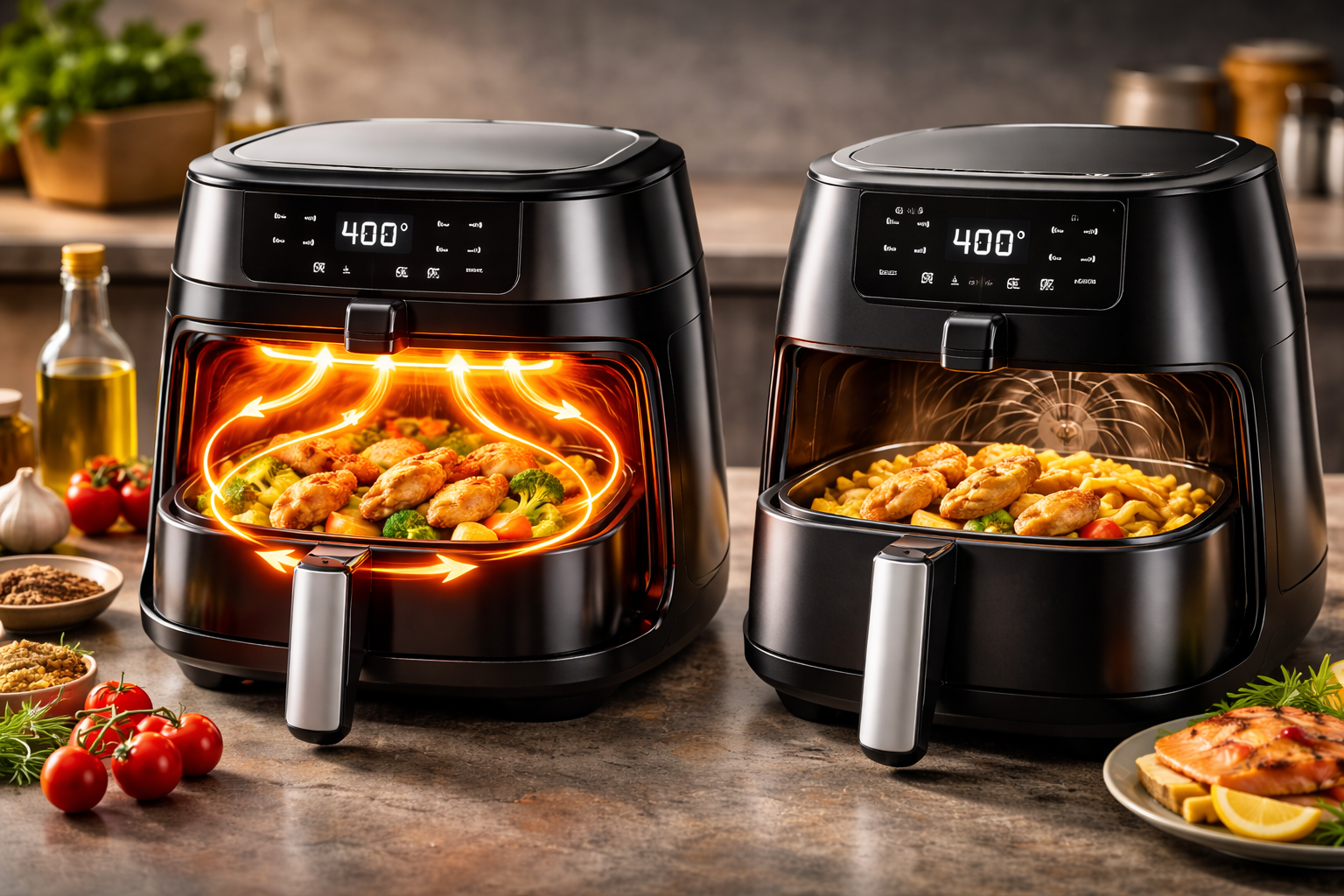
A traditional air fryer relies almost entirely on convection. An electric resistance coil heats air inside a compact chamber, and a fan circulates that air at high velocity around food. According to Science Meets Food, “the cooking process relies on a mechanism called rapid air technology, which circulates hot air around the food to cook it evenly.”
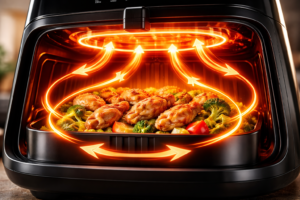
An infrared convection air fryer adds a second heat pathway. Infrared emitters generate electromagnetic radiation that transfers energy directly to food surfaces without heating air first. ScienceDirect describes infrared heating as a process that “transfers heat by electromagnetic waves directly to the product surface without the need for a heating medium.”
In practical terms, a traditional air fryer depends on air temperature and airflow uniformity. An infrared hot air fryer supplements that with surface-direct radiant energy.
Preheating and Thermal Response
Preheating behavior reveals one of the clearest operational differences. Traditional air fryers must raise the internal air mass and chamber walls to target temperature before consistent cooking begins. This process is faster than in full-size ovens but still measurable.
Infrared air fryer technology reduces reliance on air temperature equilibrium. Radiant emitters reach operating temperature rapidly and begin transferring energy as soon as they activate. Research on infrared food heating identifies “instant heating due to direct heat penetration and fast heat transfer” as defining traits.
In daily use, this means an infrared cooking air fryer may begin browning food sooner, while a traditional air fryer spends more time bringing the chamber to equilibrium.
Surface Browning and Texture Formation
Surface texture is often cited in infrared heating air fryer reviews. Browning is controlled by the Maillard reaction, which accelerates as surface temperatures rise. In convection systems, surface temperature is limited by air temperature and evaporation cooling.
Infrared radiation increases surface temperature directly. The Institute of Culinary Education explains that infrared cooking “heats the exterior of food quickly, which can improve browning while limiting overcooking of the interior.”
In a traditional air fryer, uneven airflow can produce patchy browning unless food is shaken or rearranged. Radiant heat reduces dependence on airflow patterns, producing more uniform surface exposure when food is positioned within the emitter’s line of sight.
Internal Cooking and Penetration Limits
Despite surface advantages, infrared heating does not penetrate deeply into food. Infrared radiation is absorbed primarily at or near the surface, with penetration depth governed by wavelength and food composition. Scientific literature notes that infrared energy “is absorbed at the surface and converted to heat, which then conducts inward.”
This physical limit shapes the comparison. In thick foods, both appliance types rely on conduction and convection to move heat inward. A traditional air fryer and an air fryer with infrared heating reach similar internal cooking profiles once surface differences stabilize.
Moisture Retention and Dehydration Control
Moisture management differs subtly between systems. Traditional air fryers expose food to continuous hot air flow, which can accelerate evaporation. Infrared systems concentrate energy at the surface, which may shorten exposure time.
A review published in Foods reports that infrared heating allows better control of surface moisture loss compared to conventional hot air drying. In domestic cooking, this can translate into crisp surfaces with less internal moisture loss.
Results remain food-dependent. Thin items dehydrate rapidly in both systems, while thicker foods show clearer differences.
Energy Consumption Patterns
Energy behavior is another comparison point. Air fryers as a category already outperform conventional ovens in efficiency. An analysis by GreenMatch found that air fryers use less electricity than a conventional oven for equivalent cooking tasks.
Infrared heating shifts energy transfer dynamics. Radiant energy heats food directly rather than air, reducing thermal losses associated with heating unused space. Academic research associates infrared systems with shorter processing times and lower energy consumption per unit output.
Total household energy savings still depend on insulation, emitter control, and cooking habits.
Control Systems and Temperature Stability
Traditional air fryers regulate temperature by cycling the heating element and fan. Infrared convection air fryer models require additional coordination. Radiant emitters must be modulated to prevent surface overheating while air temperature remains stable.
Modern units rely on sensors and microcontrollers to manage this balance. When calibration is poor, infrared systems can overshoot surface temperatures, producing dark exteriors before interiors reach target ranges.
Cooking Flexibility and Food Placement
Food placement matters more in infrared systems. Radiant heat travels in straight lines and affects surfaces within the emitter’s path. Foods shadowed by other items receive less infrared exposure, while convection remains omnidirectional.
Traditional air fryers distribute heat more uniformly around stacked items through airflow, though with reduced efficiency.
Safety Profiles
From a safety standpoint, both appliance types fall under the same electrical and thermal standards. Infrared emitters operate at high temperatures but remain enclosed within insulated chambers.
Fire safety authorities have warned that misuse of air fryers, such as inserting unsuitable items or blocking vents, increases risk regardless of heating method.
Consumer Perception and Technical Reality
Public perception often conflates infrared cooking with microwave heating. These technologies are unrelated. Infrared radiation heats surfaces, while microwaves excite water molecules throughout food volume.
Marketing language sometimes implies deep internal heating from infrared systems. Physical evidence does not support this interpretation.
Use Case Comparisons
- Surface browning priority: infrared heating air fryer models show consistent advantages.
- Thick food cooking: differences narrow, with convection dominating internal heat transfer.
- Batch cooking: traditional air fryers tolerate dense loading more effectively.
- Preheating sensitivity: infrared systems reduce wait time before cooking begins.
Market Positioning Versus Measured Differences
Claims surrounding the best infrared heating air fryer emphasize speed and surface quality. Scientific principles support faster surface heating and reduced preheat dependency, within known physical limits.
Traditional air fryers already represent an efficiency improvement over ovens. Infrared air fryer technology refines specific performance aspects rather than redefining the category.
Final Considerations
The comparison between an infrared heating air fryer and a traditional air fryer centers on refinement rather than replacement. Traditional air fryers rely on convection across all cooking stages. Infrared convection air fryer designs add radiant heat to accelerate surface reactions and reduce reliance on airflow alone.
Measured differences appear most clearly in browning consistency and initial heating response. Limits remain unchanged for internal heat penetration and dense food cooking. Understanding how infrared air fryers work allows expectations to align with physics rather than branding, with radiant heat acting as a targeted adjustment to convection cooking.