The modern air fryer has moved beyond its early identity as a compact convection appliance. Over the past few years, manufacturers have introduced models marketed as an infrared heating air fryer, blending radiant heat with forced hot air circulation. This shift reflects broader developments in food engineering, where different heat-transfer methods are combined to manage speed, surface texture, and energy use with greater precision.
Understanding how infrared air fryer technology functions requires separating marketing language from physical principles. Infrared heating is not new, nor is convection cooking. What is new is how these two methods are arranged inside consumer appliances and what that arrangement changes during everyday cooking.
This article examines how infrared air fryers work from a technical standpoint, drawing on established research in thermal physics and food science. It also evaluates what infrared heating adds to an air fryer, where its limits appear, and how current claims align with measurable properties of radiant heat.
The Physics Behind Infrared Heating
Infrared radiation is part of the electromagnetic spectrum, located between visible light and microwaves. According to the U.S. National Aeronautics and Space Administration, “infrared radiation is electromagnetic radiation with longer wavelengths than visible light, extending from the nominal red edge of the visible spectrum at about 0.7 micrometers to 1 millimeter.” This radiation carries energy that converts into heat when absorbed by matter.
In cooking systems, infrared energy heats objects directly rather than heating the surrounding air first. A technical overview published by ScienceDirect describes infrared heating as a method that “transfers heat by electromagnetic waves directly to the product surface without the need for a heating medium.” This property distinguishes it from convection, where air acts as an intermediary.
When food absorbs infrared radiation, molecules at or near the surface begin vibrating faster, producing thermal energy. This process occurs almost instantly once the emitter reaches operating temperature, which explains why infrared systems are often associated with short warm-up times.
Conventional Air Fryer Heat Transfer
Standard air fryers rely on convection. An electric heating element warms air inside a compact chamber, and a high-speed fan circulates that air around food. According to Science Meets Food, “the cooking process relies on a mechanism called rapid air technology, which circulates hot air around the food to cook it evenly.” Heat reaches the food through contact with hot air and through conduction from the surface inward.
This approach has clear advantages. Air fryers reduce cooking time relative to full-size ovens, limit oil use, and consume less energy per cooking cycle. An analysis of household appliance efficiency published by GreenMatch reports that air fryers typically use less electricity than a conventional oven for equivalent cooking tasks.
Yet convection alone has limitations. Air is a poor heat conductor, and airflow patterns can be disrupted by food placement. This sometimes leads to uneven browning or the need for manual shaking and repositioning.
How Infrared Air Fryers Work in Practice
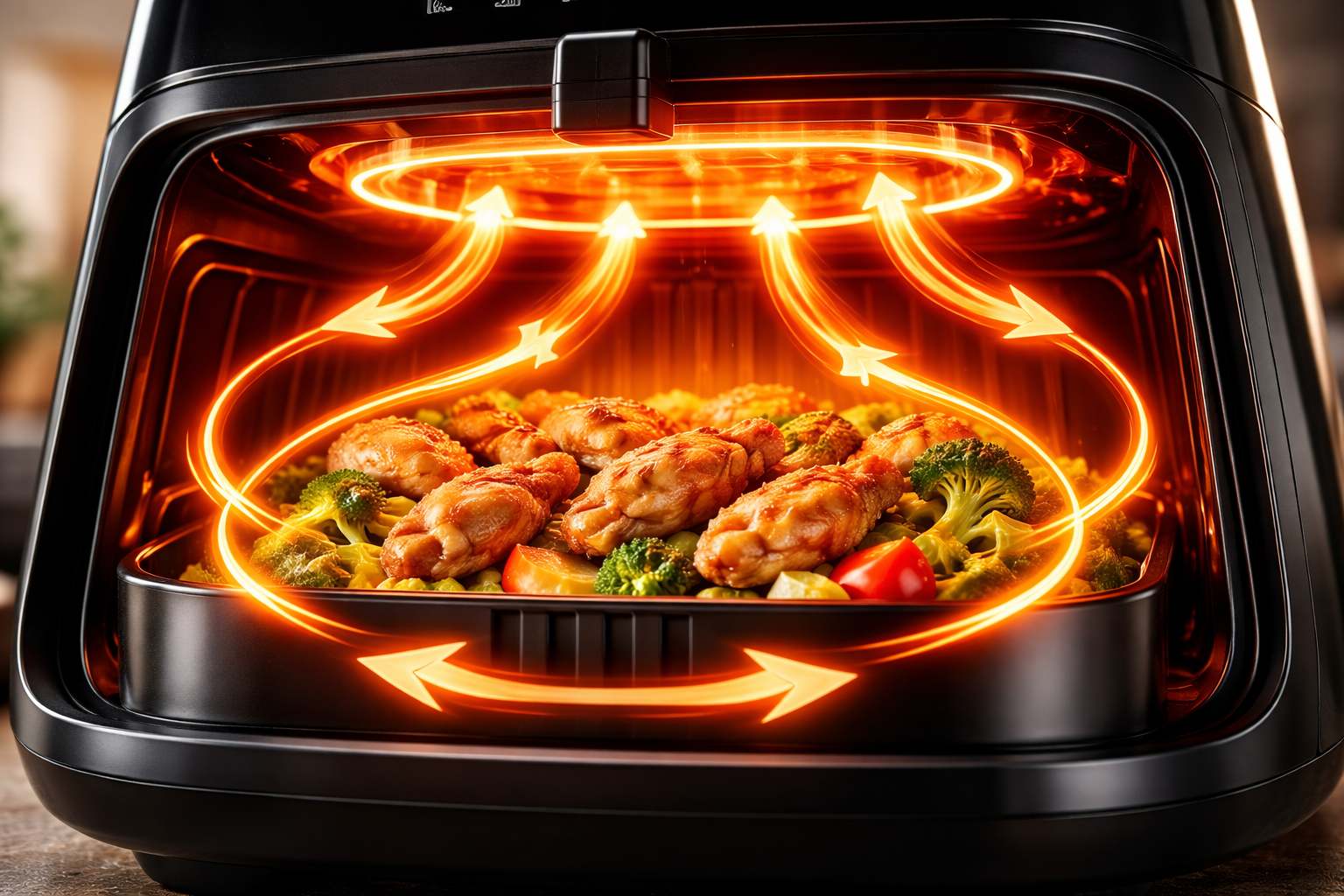
An air fryer with infrared heating introduces radiant heat as a parallel pathway for energy transfer. Inside these units, infrared emitters are placed near the top or sides of the cooking chamber. As the emitters heat up, they project infrared radiation directly onto exposed food surfaces while a fan continues to circulate hot air.
The result is a hybrid system. Convection handles overall temperature balance and internal heat migration, while infrared radiation concentrates energy at the surface. Food science literature describes this combination as beneficial for surface reactions. A review in the journal Foods notes that infrared heating offers “rapid heating rates and improved surface heating efficiency,” particularly when paired with other methods such as convection.
This configuration explains how infrared convection air fryer models aim to reduce preheating time. Since radiant heat does not require the air to reach equilibrium first, food begins absorbing energy as soon as the emitters activate.
Surface Browning and the Maillard Reaction
One of the most discussed aspects of infrared cooking air fryer designs is surface browning. Browning is governed largely by the Maillard reaction, a chemical process between amino acids and reducing sugars that accelerates at higher surface temperatures.
Infrared radiation raises surface temperatures quickly, which can support faster onset of browning reactions. The Institute of Culinary Education explains that infrared cooking “heats the exterior of food quickly, which can improve browning while limiting overcooking of the interior.” This aligns with controlled experiments in food processing, where infrared systems are used to improve color development on baked and roasted products.
In a conventional air fryer, surface temperature depends on air temperature and airflow velocity. With infrared assistance, radiant energy adds another input, less dependent on airflow uniformity. This is one reason infrared hot air fryer designs often advertise reduced need for shaking or turning food during cooking.
Heat Penetration and Its Limits
Despite these advantages, infrared heating has physical limits. Infrared radiation penetrates only a short distance into most foods. Scientific literature notes that infrared energy is absorbed primarily at the surface, with penetration depth depending on wavelength and material properties.
This means that while surface heating accelerates, internal cooking still relies on conduction and convection. For thick cuts of meat or dense foods, infrared energy alone cannot produce uniform internal temperatures. The air fryer’s fan and hot air remain responsible for transferring heat inward.
This duality shapes how infrared air fryer benefits should be interpreted. Radiant heat improves surface conditions, while convection governs interior doneness.
Energy Transfer and Efficiency
Energy efficiency claims surrounding the best infrared heating air fryer models often reference reduced preheat times and focused energy delivery. These claims reflect established thermal principles.
Infrared systems transfer energy directly to food rather than warming surrounding air first. This reduces thermal losses linked to heating unused space. Academic reviews of infrared heating in food applications indicate that the method can reduce energy consumption by shortening processing time and improving heat transfer efficiency.
Air fryers already benefit from small chamber size. Adding infrared emitters may further concentrate energy where it matters most. Still, overall efficiency depends on insulation quality, emitter design, and fan control.
Moisture Retention and Texture
Another claimed advantage of infrared heating air fryer designs involves moisture management. Rapid surface heating can limit excessive moisture escape during early cooking stages. This principle is well documented in industrial food processing, where infrared systems are used to regulate dehydration rates.
Research published in Foods reports that infrared heating allows better control of surface moisture loss compared to conventional hot air drying. In domestic cooking, this can translate into crisp exteriors paired with less internal moisture loss, particularly for vegetables and proteins.
Results still vary by food type and preparation. Thin foods may lose moisture rapidly regardless of heating method.
Control Systems and Temperature Regulation
Modern infrared air fryer technology relies on electronic control systems to regulate emitter output and airflow. Thermostats, temperature sensors, and microcontrollers coordinate radiant and convective heat to maintain target temperatures.
In poorly calibrated systems, infrared emitters could overshoot surface temperatures, leading to uneven results. Well-designed units modulate radiant output in response to chamber temperature feedback. This coordination is necessary for consistency and safety.
Consumer infrared heating air fryer reviews often reflect these design differences. Variability in user experience frequently correlates with how precisely manufacturers manage radiant output.
Safety Considerations
Infrared air fryers do not introduce new categories of household risk beyond standard electrical cooking appliances. Infrared emitters operate at high temperatures yet remain enclosed within insulated chambers.
General air fryer safety guidance still applies. Avoid overcrowding, maintain ventilation clearance, and follow temperature guidelines. Fire safety authorities have cautioned that misuse of air fryers, such as placing incompatible items inside, can increase fire risk, regardless of heating method.
Market Perception Versus Technical Reality
Public perception of infrared cooking air fryer models often blurs the distinction between infrared heating and microwave cooking. These technologies are unrelated. Infrared radiation heats surfaces, while microwaves excite water molecules throughout food volume.
Marketing language sometimes implies deep penetration or internal heating from infrared systems. Physical evidence does not support this. Infrared radiation remains surface-dominant, acting as a complement to convection rather than a replacement.
Understanding this distinction helps contextualize infrared heating air fryer reviews that report faster browning yet similar total cook times for thick foods.
Comparing Infrared and Conventional Air Fryers
From a technical standpoint, an infrared air fryer refines rather than redefines air frying. The core cooking mechanism remains convection. Infrared elements act as accelerators for surface heat transfer.
For users prioritizing browning quality and reduced preheat time, infrared convection air fryer designs offer measurable differences. For users focused on volume cooking or internal doneness of large foods, differences may appear modest.
This explains why infrared air fryer benefits vary across use cases rather than presenting uniform gains.
Final Considerations
Infrared heating technology works in air fryers by adding a radiant heat pathway to an established convection system. Infrared emitters deliver energy directly to food surfaces, accelerating surface heating and supporting faster browning reactions. Convection air flow continues to manage internal temperature distribution and overall heat balance.
Scientific literature supports many of the underlying principles cited by manufacturers, including rapid heat transfer and improved surface efficiency. At the same time, physical limits of infrared penetration remain unchanged, and internal cooking still depends on conventional heat transfer methods.
An infrared heating air fryer represents a technical adjustment rather than a conceptual shift. Its effectiveness depends on thoughtful integration of radiant and convective systems, accurate temperature control, and realistic expectations about what infrared heat can and cannot do inside a compact cooking chamber.