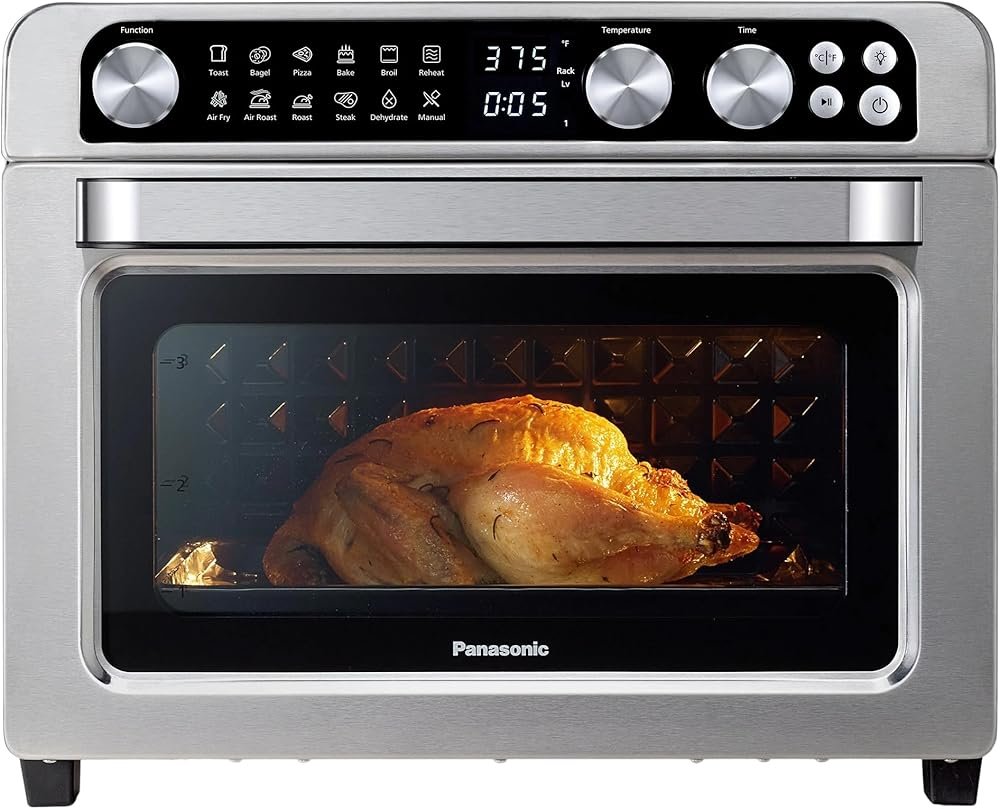
Countertop ovens occupy a complicated space in domestic kitchens. They are expected to replicate the reliability of full-size ovens while adapting to smaller footprints, faster routines, and changing family structures. Over the past decade, that tension has intensified as air frying, infrared heating, and multi-function presets converged into hybrid appliances. The Panasonic FlashXpress Infrared Air Fryer Toaster Oven, Family Size sits at the center of that convergence, combining long-standing infrared heating principles with contemporary expectations around speed, consistency, and energy discipline.
This article examines the FlashXpress not as a lifestyle object but as an engineering response to shifting household behavior. By situating the appliance within food science research, energy data, and broader market trends, the analysis seeks to clarify what infrared toaster ovens contribute to modern cooking and where their limitations remain.
Infrared Heating as a Legacy Technology, Not a Trend
Infrared cooking is frequently framed as a recent innovation, yet its roots extend deep into industrial food processing and materials engineering. Radiant heating systems have long been used in commercial ovens, particularly where surface browning and rapid heat transfer are priorities. The U.S. Department of Energy defines infrared heating as a process that “transfers energy directly to the product through electromagnetic waves, without heating the surrounding air first,” a mechanism that reduces warm-up losses and accelerates surface temperature rise. This definition appears in technical guidance from the U.S. Department of Energy.
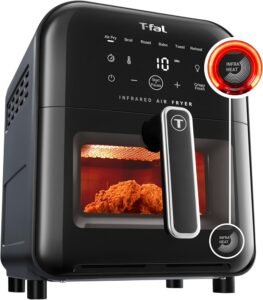
Panasonic’s FlashXpress platform draws directly from this principle. Unlike convection-only air fryers that rely on high-velocity airflow, the FlashXpress uses dual infrared elements positioned above and below the food. This configuration emphasizes radiant exposure rather than turbulent air movement, a distinction that affects cooking outcomes in subtle but measurable ways.
Infrared heating favors consistency for flat or thin foods, such as toast, fish fillets, or reheated leftovers. Heat reaches the food surface immediately, reducing reliance on preheating and minimizing thermal lag.
Family Size Capacity and the Logic of Scale
The family size designation reflects more than interior volume. It signals an assumption about how meals are prepared and served. According to household data published by the U.S. Census Bureau, multi-person households continue to prepare meals at home more frequently than single-person households, even as overall cooking time declines. These patterns are outlined in demographic reporting from the U.S. Census Bureau.
Panasonic positions the FlashXpress as capable of handling multiple servings without transitioning into full countertop oven territory. Its interior accommodates standard cookware sizes and multiple food items laid flat rather than stacked. This design choice aligns with infrared’s strengths, as radiant heat performs best when surfaces are directly exposed.
Stacking, common in basket-style air fryers, reduces infrared effectiveness. By prioritizing surface area over vertical depth, Panasonic implicitly favors even exposure over batch density.
Infrared Versus High-Velocity Air Frying
Comparisons between infrared toaster ovens and fan-driven air fryers often conflate speed with airflow. In reality, the two systems optimize different variables. High-velocity air fryers, such as those evaluated in a typical cosori turboblaze air fryer review, rely on rapid convective heat transfer to accelerate dehydration and browning. Infrared systems rely on direct radiant energy.
Harvard Health Publishing describes air fryers as appliances that cook by “circulating hot air at high speed,” producing browning reactions with limited oil use. This description appears in public health guidance from Harvard Health Publishing.
The trade-off appears in texture. Air fryers excel at crisping irregular or breaded foods. Infrared ovens favor uniform browning and moisture retention, particularly for proteins and baked items.
Temperature Precision and Control Architecture
One of the FlashXpress’s defining traits is temperature stability. Infrared elements reach target output almost instantly and maintain consistent radiant intensity. This supports precise temperature air fryer behavior without heavy reliance on fan modulation.
Control-system research in small appliances shows that reducing warm-up variability improves repeatability across cooking cycles. These findings are discussed in engineering literature indexed through IEEE Xplore.
This precision becomes relevant when compared with high heat air fryer oven designs that operate near maximum thresholds to shorten cook times. Infrared systems achieve speed without pushing air temperatures to extremes, a distinction with implications for both texture and material wear.
Even Cooking Without Turbulence
Even cooking air fryer claims typically rest on airflow uniformity. In contrast, the FlashXpress pursues evenness through symmetrical radiant exposure. Food receives heat from both above and below, reducing gradients that can lead to uneven doneness.
Engineering studies on radiant heating indicate that bidirectional exposure reduces surface temperature variance, particularly for thin food profiles. These principles are outlined in thermal engineering references available through ScienceDirect.
This explains why infrared toaster ovens perform reliably for toast and reheating, tasks where convection systems sometimes over-dry edges while underheating centers. The FlashXpress trades volumetric throughput for surface consistency.
Energy Use and Household Efficiency
Energy discipline increasingly shapes appliance adoption. The U.S. Energy Information Administration reports that countertop cooking appliances often consume less total energy than conventional ovens, especially when preheating is avoided. This comparison appears in residential energy analysis from the U.S. Energy Information Administration.
Infrared systems align with this efficiency pattern. Immediate radiant output reduces idle consumption. While instantaneous wattage remains comparable to other countertop ovens, cumulative usage often falls when meals involve reheating or short cooking cycles.
This efficiency advantage parallels findings in studies of forced convection systems, where preheating accounted for a substantial portion of total energy use in traditional ovens.
Materials, Coatings, and Consumer Safety
Unlike basket air fryers that emphasize coatings such as those highlighted in discussions of a cosori ceramic coated air fryer, the FlashXpress relies primarily on metal trays and racks. This reduces dependence on nonstick surfaces and simplifies material aging.
The U.S. Food and Drug Administration notes that PTFE-based coatings are safe for household use within recommended temperature limits, though alternative materials appeal to consumers seeking reduced coating exposure. This guidance appears in consumer safety materials from the Food and Drug Administration.
Panasonic’s material choices align with its heating method. Radiant exposure favors stable, reflective surfaces rather than coated baskets that may degrade under repeated high heat.
Health Outcomes and Cooking Chemistry
Air frying and infrared cooking share a common narrative around reduced oil use. A study published in the Journal of Food Science found that air-fried potatoes contained “significantly lower fat content than deep-fried samples,” while maintaining acceptable sensory qualities. The study is accessible through the Institute of Food Technologists online library.
Infrared cooking achieves similar reductions by eliminating oil immersion rather than by airflow. Yet cooking chemistry introduces other variables. The World Health Organization notes that high-temperature cooking methods can increase acrylamide formation in starchy foods, influenced by both temperature and time. This information appears in food safety guidance from the World Health Organization.
Market Position Relative to Modern Air Fryers
The countertop cooking market now spans compact basket fryers, multi-zone ovens, and hybrid systems with 9 in 1 air fryer functions. Products like the cosori 6 qt air fryer emphasize versatility and airflow intensity, supported by digital interfaces and preset logic.
The FlashXpress diverges from this trajectory. It does not chase turboblaze air fryer performance metrics or expand into layered cooking. Instead, it refines a narrower use case: reliable, flat-surface cooking at family scale.
This positioning reflects a segmentation in consumer behavior. Some households prioritize versatility and batch density. Others value predictability and reduced intervention.
User Interaction and Learning Curves
Panasonic’s interface favors simplicity. Limited presets and mechanical controls reduce cognitive load. Human-computer interaction research suggests that simpler interfaces lower error rates for routine tasks, particularly among multi-user households. These dynamics are discussed in peer-reviewed research available via Taylor & Francis Online.
In contrast, digital air fryers with extensive preset menus, such as those featuring cosori digital air fryer features, reward experimentation but introduce variability. FlashXpress’s restraint reflects confidence in its heating method rather than reliance on algorithmic correction.
Durability, Maintenance, and Long-Term Use
Maintenance patterns influence long-term satisfaction more than initial performance. Consumer research consistently ranks cleaning effort as a primary determinant of appliance approval.
The FlashXpress benefits from minimal internal complexity. No fan assemblies reduce mechanical wear. Smooth interior surfaces simplify cleaning. Absence of deep baskets minimizes grease accumulation.
Durability stems from fewer moving parts, a principle long recognized in appliance engineering.
Contextual Comparison With Ceramic Basket Air Fryers
Air fryers featuring a premium ceramic air fryer basket address different concerns: food release, cleaning ease, and coating longevity. These attributes matter in basket-based designs where food contact is continuous.
Infrared toaster ovens shift that equation. Food rests on racks or trays rather than enclosed baskets. This reduces reliance on coatings and reframes the maintenance equation.
As such, direct comparisons between the FlashXpress and ceramic-coated air fryers should account for fundamental design differences rather than feature parity.
Final Considerations
The Panasonic FlashXpress Infrared Air Fryer Toaster Oven, Family Size represents a deliberate alternative to airflow-centric air fryers. Its strength lies in radiant consistency, temperature stability, and material simplicity rather than in expanding function counts or maximizing turbulence.
In a market increasingly defined by complexity, the FlashXpress illustrates another path: refinement of a proven heating principle adapted to contemporary household scale. As kitchens continue to fragment across routines and expectations, infrared systems remain relevant not through novelty, but through alignment with how many families actually cook.