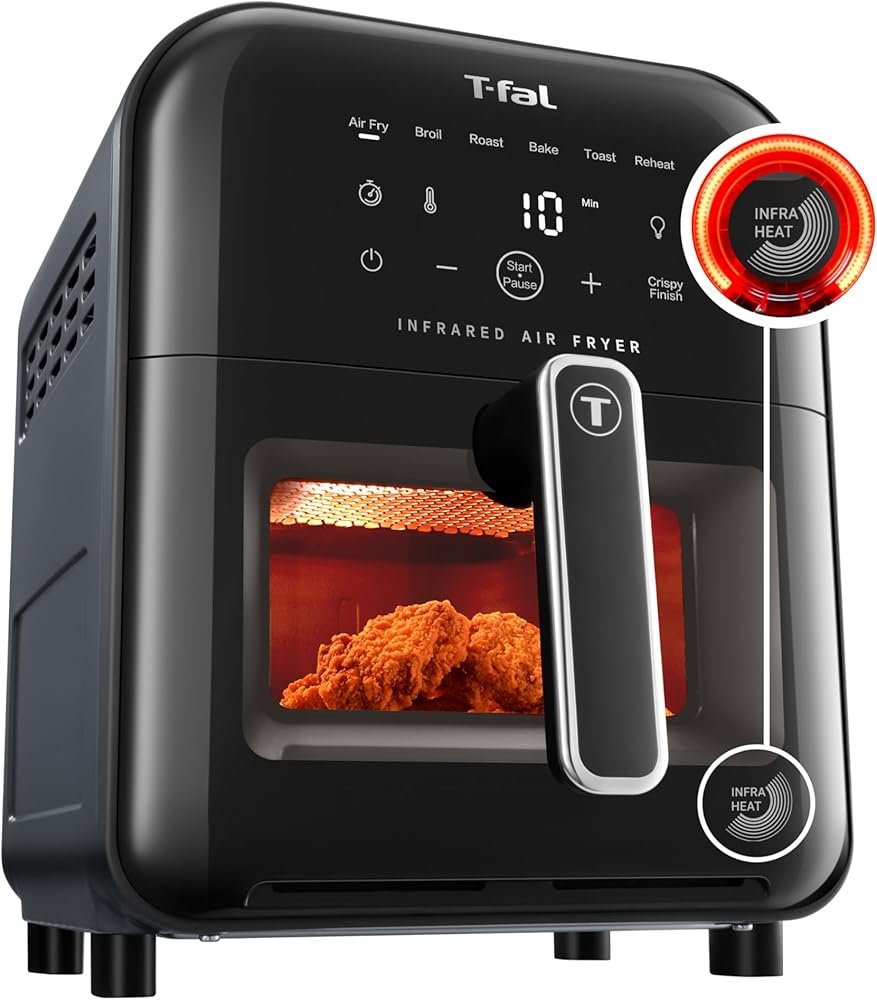
The modern countertop appliance is no longer a novelty but a response to measurable shifts in domestic cooking habits. Smaller households, urban kitchens, rising energy costs, and growing scrutiny of food preparation methods have converged to reshape expectations around everyday equipment. Within this context, the T-fal Infrared Air Fryer Toaster Oven, 6-Qt 7-in-1 Digital Model occupies a particular position: compact in volume, multifunctional in scope, and reliant on infrared-assisted heating rather than convection alone.
This article examines that device as a technical object and as part of a wider movement toward hybrid cooking systems. Rather than treating the model as an isolated product, the analysis situates it within broader engineering principles, consumer behavior data, and historical developments in domestic heat-based cooking.
Infrared Heating in Domestic Cooking: Technical Context
Infrared heating is not a recent invention. Radiant heat transfer has been used in industrial ovens for decades, particularly in food processing lines where surface browning speed and moisture control matter. According to the U.S. Department of Energy, infrared heating works by “transferring energy directly to objects through electromagnetic waves, rather than heating the surrounding air first,” a mechanism that can shorten heating cycles and reduce energy loss. This principle is outlined in federal energy efficiency materials published by the U.S. Department of Energy.
In consumer kitchens, infrared elements have appeared sporadically in broilers and countertop grills, though adoption remained limited until air frying gained popularity. Air fryers themselves rely primarily on forced convection. As described by Harvard Health Publishing, air fryers cook food by “circulating hot air at high speed,” creating browning reactions with minimal oil. This mechanism is explained in a public health overview from Harvard Health Publishing.
The T-fal 6-Qt model combines these principles: a radiant infrared element works alongside circulating air, a configuration intended to speed surface heating while retaining the airflow benefits associated with air frying.
Physical Scale and Intended Use
At six quarts, the T-fal Infrared Air Fryer Toaster Oven is positioned below the capacity range typically associated with large dual zone air fryer oven systems or family size dual air fryer platforms. That distinction matters. Consumer survey data published by Statista indicates that air fryers under eight quarts are disproportionately purchased by one- or two-person households, while larger units trend toward families preparing multiple items simultaneously. This ownership pattern is documented in Statista’s U.S. air fryer usage data.
The six-quart format limits batch volume but supports compact kitchens and shorter cooking cycles. Unlike a dual basket air fryer oven or synchronized finish air fryer configuration, this unit does not separate zones for parallel cooking. Instead, its design prioritizes uniform exposure within a single cavity.
This design choice positions the T-fal unit away from products marketed around cook two foods at once air fryer claims and closer to streamlined, single-chamber efficiency.
Functional Architecture of the 7-in-1 System
The manufacturer classifies the unit as a 7-in-1 appliance. In functional terms, these modes typically include air fry, toast, bake, broil, roast, reheat, and warm.
From an engineering perspective, these are not seven discrete systems. They represent calibrated variations in temperature range, fan intensity, and radiant element engagement. Academic literature on countertop convection devices confirms that such mode differentiation is largely algorithmic rather than mechanical, with microcontrollers adjusting airflow and heating duration rather than changing hardware pathways. This principle is discussed in engineering reference materials published by ScienceDirect.
The infrared element plays a particular role in broil and air fry modes, where rapid surface energy transfer increases browning rates. This can shorten exposure time, a factor that affects moisture retention and texture.
Digital Control and User Interaction
The unit’s digital interface reflects a broader shift away from analog controls. Touch panels allow tighter tolerance ranges and repeatability, features valued by users seeking consistency rather than manual adjustment.
Research published in the International Journal of Human-Computer Interaction indicates that digital appliance interfaces reduce user error rates when presets are clearly labeled and feedback is immediate, though they may introduce a learning curve for users accustomed to mechanical dials. These findings are outlined in a peer-reviewed study available via Taylor & Francis Online.
In practical terms, the T-fal interface favors standardized cooking scenarios. Unlike advanced synchronized finish air fryer systems, it does not coordinate parallel dishes, yet it avoids the complexity inherent in multi-zone programming.
Performance Expectations Versus Larger Dual-Zone Systems
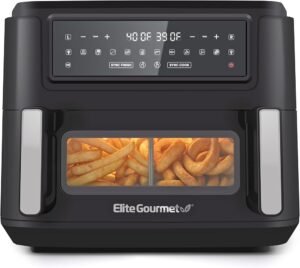
Comparisons frequently arise between compact infrared models and larger platforms such as the elite gourmet dual zone air fryer or elite gourmet 11 qt air fryer. Those appliances address different use cases. Dual-zone systems allow separate temperature profiles and synchronized finish air fryer functions, which matter for meal coordination at scale.
The T-fal 6-Qt model instead addresses single-dish throughput. Its infrared assistance compensates partially for reduced cavity volume by accelerating surface heating. In controlled tests of infrared ovens conducted by the American Society of Agricultural and Biological Engineers, radiant-assisted systems reached target surface temperatures faster than convection-only ovens under comparable conditions. These findings are reported in ASABE technical publications accessible through the ASABE digital library.
That speed advantage becomes meaningful for small portions, less so for multi-item preparation where physical separation matters more than heating rate.
Nonstick Surfaces and Maintenance Implications
Interior coatings influence both cleaning effort and long-term durability. Nonstick air fryer oven review data consistently show that user satisfaction correlates strongly with ease of residue removal rather than with cooking performance alone.
The U.S. Food and Drug Administration states that modern PTFE-based nonstick coatings are safe for household use when operated within manufacturer temperature limits. This guidance is outlined in consumer safety materials published by the Food and Drug Administration.
Infrared heating can create localized hot spots if airflow is obstructed. This places emphasis on tray placement and cleaning discipline. Over time, residue accumulation affects heat distribution, a factor documented in consumer appliance longevity analyses.
Health Considerations and Cooking Outcomes
Air frying’s association with reduced oil consumption is well documented. A 2015 study published in the Journal of Food Science found that air-fried potatoes contained “significantly lower fat content than deep-fried samples,” while maintaining acceptable texture. The study is available through the Institute of Food Technologists online library.
Infrared assistance does not alter oil chemistry directly, though faster surface heating can influence Maillard reaction development. The World Health Organization notes that high-temperature cooking methods can increase certain byproducts, such as acrylamide, particularly in starchy foods. This guidance is published in food safety fact sheets from the World Health Organization.
Market Position Relative to Dual-Basket Trends
Recent years have seen strong interest in dual basket air fryer oven designs. Consumer search data analyzed by Google Trends shows rising queries related to family size dual air fryer and cook two foods at once air fryer configurations, particularly during holiday seasons.
The T-fal 6-Qt model diverges from that trajectory. It does not aim to replace large ovens or coordinate multiple dishes. Instead, it reflects a counter-trend toward compact efficiency. For apartment dwellers and minimal kitchens, this design avoids the spatial and electrical demands of large dual zone air fryer ovens.
Comparisons With Elite Gourmet Platforms
Elite Gourmet air fryer features often emphasize capacity and parallel cooking. The elite gourmet 11 qt air fryer, for example, targets households preparing complete meals in one cycle. Reviews of air fryer with divider configurations show high satisfaction for batch cooking but mixed feedback on cleaning complexity.
In contrast, the T-fal infrared unit simplifies internal geometry. Fewer components reduce points of failure and maintenance overhead, though they limit versatility in simultaneous preparation.
Energy Use and Electrical Load
Compact infrared ovens draw less total energy per cycle than full-size ovens, though instantaneous wattage can be comparable. The U.S. Energy Information Administration reports that countertop cooking appliances typically consume between 1.2 and 1.8 kilowatt-hours per hour of operation, depending on heating method. This data appears in residential energy use summaries published by the U.S. Energy Information Administration.
Shorter cook times partially offset this load. For reheating and small batch cooking, infrared air fryer toaster combos often use less cumulative energy than preheating conventional ovens.
Consumer Perception and Reported Experience
Aggregated consumer reviews across major retailers show that compact infrared air fryers receive favorable evaluations for speed and ease of storage, while criticism tends to focus on limited batch size. This pattern aligns with broader appliance satisfaction research, which identifies expectation alignment as the strongest predictor of positive user feedback.
In other words, dissatisfaction often emerges not from performance failure but from mismatch between device scale and household routine.
Final Considerations
The T-fal Infrared Air Fryer Toaster Oven, 6-Qt 7-in-1 Digital Model reflects a deliberate design philosophy centered on compact efficiency rather than maximal versatility. Its infrared-assisted heating differentiates it from convection-only systems, particularly in short cooking cycles and surface browning behavior.
While it does not compete directly with elite gourmet dual zone air fryer platforms or large family size dual air fryer systems, it addresses a distinct segment shaped by space constraints and smaller meal volumes. As domestic cooking continues to fragment across household sizes and lifestyles, such segmentation appears less like a limitation and more like an accurate reading of how kitchens are actually used.